
Expressing Emotions — 감정 표현
Read the lesson, then practise at your own pace. All explanations and examples are on this page.
Core Emotions 기본 감정
Emotions in Korean (감정)
Korean emotion words are mostly adjectives in their base form. Unlike English ('I am happy'), Korean adjectives act like verbs and conjugate directly: 행복해요 (I am happy) without needing a separate 'am'. The dictionary form ends in -다: 행복하다, 슬프다, 무섭다. Drop -다 and add -아요/-어요 for the polite present tense. Emotion vocabulary is especially useful for talking about K-dramas, daily life, and personal feelings.
Words and phrases
| Korean | Pronunciation | Meaning |
|---|---|---|
| 행복하다 | haeng-bok-ha-da | to be happy (dictionary form) |
| 슬프다 | seul-peu-da | to be sad (dictionary form) |
| 화가 나다 | hwa-ga na-da | to be angry (literally: anger comes out) |
| 무섭다 | mu-seop-da | to be scared / scary |
Check your understanding
Conjugating Emotion Adjectives 감정 형용사 활용
To use emotion adjectives in polite conversation, remove -다 from the dictionary form and add the polite present ending. For stems ending in 하: 하다 → 해요 (행복하다 → 행복해요). For stems ending in a bright vowel (ㅏ, ㅗ): add -아요. For all others: add -어요, usually with a vowel change — 슬프다 drops its ㅡ: 슬프 + 어요 → 슬퍼요. Stems ending in ㅂ are irregular: the ㅂ turns into 우, so 무섭다 → 무서우 + 어요 → 무서워요 (likewise 외롭다 → 외로워요, 부끄럽다 → 부끄러워요). The same pattern applies to most Korean descriptive verbs (adjectives).
Words and phrases
AI-generated learning illustration
| Korean | Pronunciation | Meaning |
|---|---|---|
 행복해요 행복해요 | haeng-bok-hae-yo | I am happy / It's happy (polite present) |
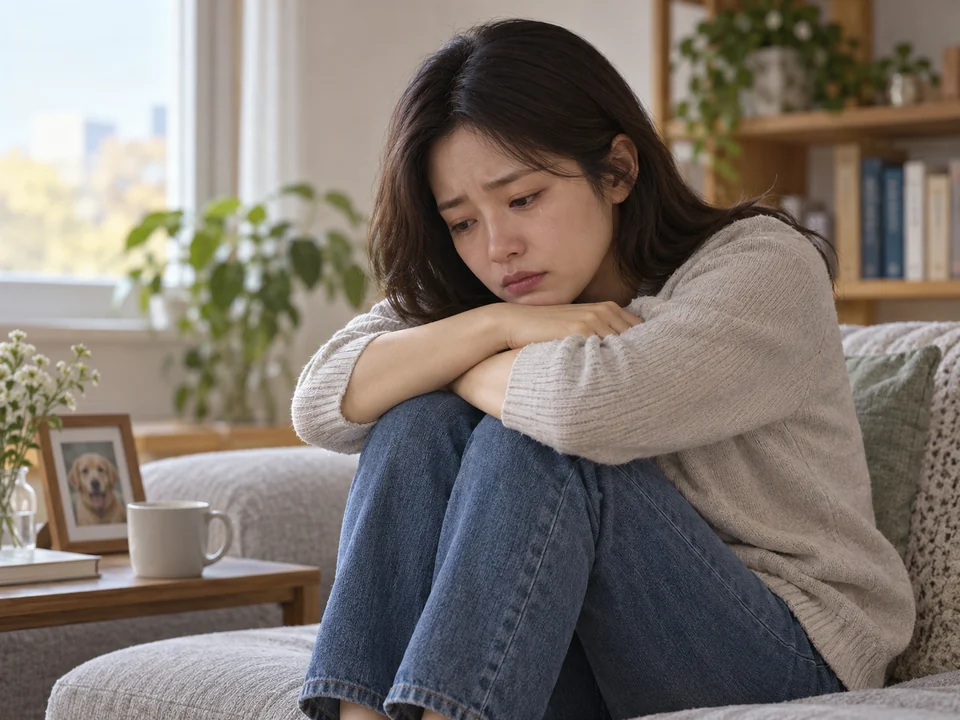 슬퍼요 슬퍼요 | seul-peo-yo | I am sad (polite present) |
Expressing Feelings 감정 표현
More Feeling Words (감정 어휘)
Korean has a rich set of emotion words beyond the basics. 기쁘다 (to be glad/joyful) is a slightly stronger or more specific happiness than 행복하다. 걱정되다 (to be worried) literally means 'worry becomes/happens'. 신나다 (to be excited/pumped) is commonly used for energetic situations — concerts, sports, celebrations. 피곤하다 (to be tired) is essential for everyday life, especially when explaining you can't do something.
Words and phrases
| Korean | Pronunciation | Meaning |
|---|---|---|
| 기쁘다 | gi-ppeu-da | to be glad / joyful |
| 걱정되다 | geok-jeong-doe-da | to be worried |
| 피곤하다 | pi-gon-ha-da | to be tired / exhausted |
| 신나다 | sin-na-da | to be excited / pumped up |
Check your understanding
기분 — Mood & Feeling
기분 (gibun) is the key word for describing your mood or general feeling state. 기분이 좋다 (gibuni jota) = to feel good / to be in a good mood. 기분이 나쁘다 = to feel bad / to be in a bad mood. 기분 can describe emotional tone more broadly than single-emotion words — it's about your overall state. You'll hear 기분이 어때요? (How are you feeling?) in everyday conversation.
Words and phrases
| Korean | Pronunciation | Meaning |
|---|---|---|
| 기분이 좋아요 | gi-bun-i jo-a-yo | I feel good / I'm in a good mood |
Check your understanding
Complex Emotions 복잡한 감정
Deeper Emotions (깊은 감정)
Korean has several emotion words with no single-word English equivalent. 그립다 (geuripda) describes missing someone or something — the longing for an absent person or place you love. 외롭다 (oeropda) is loneliness, but with a cultural depth of isolation. 부끄럽다 (bukkeureupda) is embarrassment or shyness. 뿌듯하다 (ppudeuthada) is the warm pride or satisfaction of accomplishment — the feeling you get when you finish something hard or watch someone you care about succeed.
Words and phrases
| Korean | Pronunciation | Meaning |
|---|---|---|
| 그립다 | geu-rip-da | to miss someone/something (longing) |
| 외롭다 | oe-rop-da | to be lonely |
| 부끄럽다 | bu-kkeu-reop-da | to be embarrassed / shy |
| 뿌듯하다 | ppu-deut-ha-da | to feel proud / fulfilling (warm sense of accomplishment) |
Check your understanding
Words and phrases
| Korean | Pronunciation | Meaning |
|---|---|---|
| 설레다 | seol-le-da | to feel fluttery excitement / heart fluttering (romantic anticipation) |
Check your understanding
Emotional Phrases 감정 문장
Common Emotional Sentence Patterns 감정 표현 문장
Several sentence patterns are especially useful for expressing emotions in Korean. '보고 싶어요' (I miss you / I want to see you) uses 보다 (to see) + -고 싶다 (to want to). '감동받았어요' (I was moved/touched) uses 감동 (deep emotion) + 받다 (to receive). '괜찮아요' (I'm okay / That's fine) is one of the most versatile phrases — used for 'I'm fine', 'it's okay', 'no problem', and 'never mind'.
Words and phrases
| Korean | Pronunciation | Meaning |
|---|---|---|
| 보고 싶어요 | bo-go si-peo-yo | I miss you / I want to see you |
| 감동받았어요 | gam-dong-ba-da-sseo-yo | I was moved / touched (emotionally) |
| 괜찮아요 | gwaen-chan-a-yo | I'm okay / That's fine / No problem |
Check your understanding
Words and phrases
| Korean | Pronunciation | Meaning |
|---|---|---|
| 힘내세요 | him-nae-se-yo | Cheer up! / Hang in there! (literally: put out strength) |